
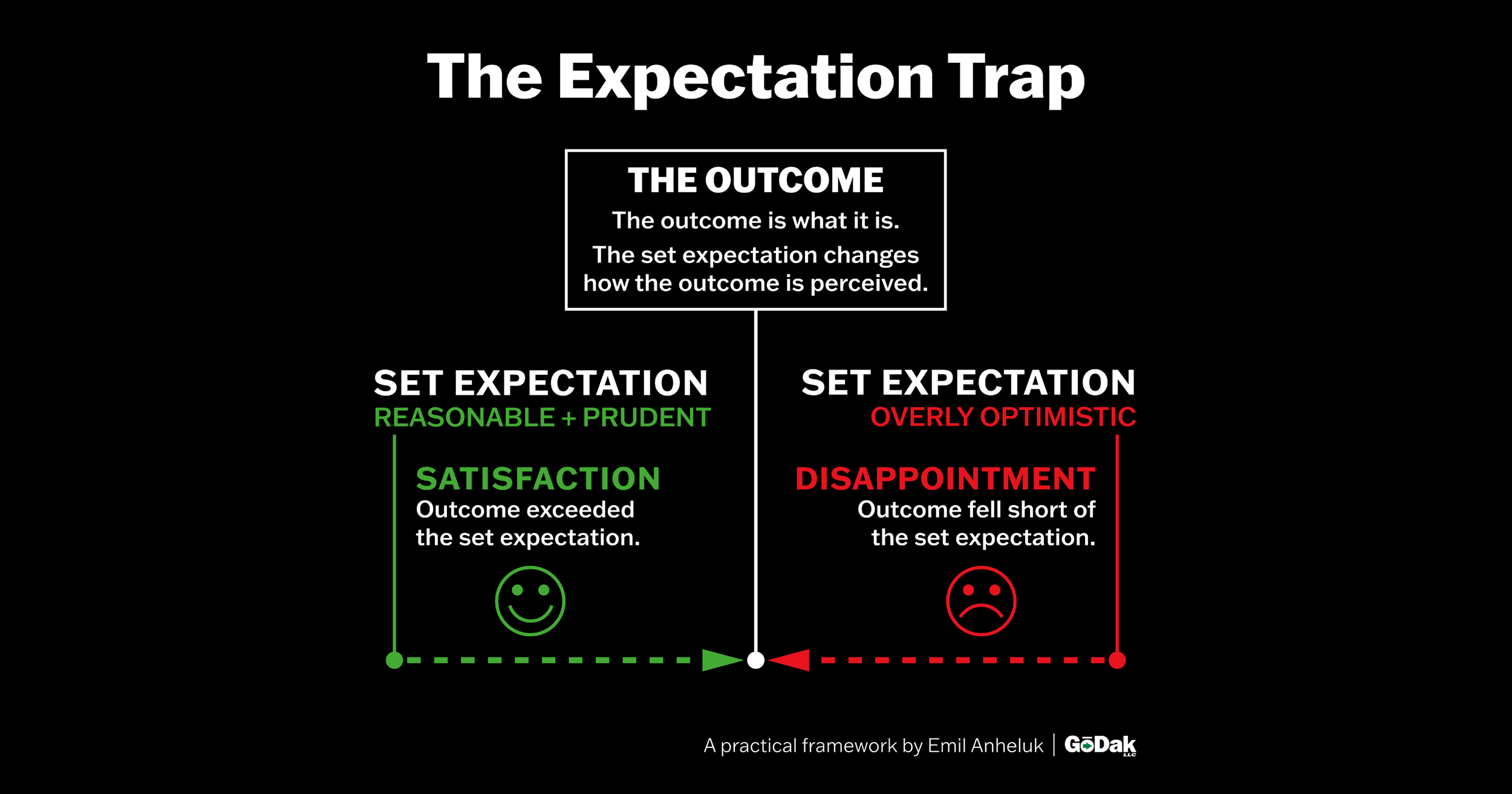
We have all fallen into the Expectation Trap. It is a very human thing to do.
It helps explain why:
New Year’s resolutions fail.
Customers become frustrated.
Employees can make real progress and still feel defeated.
A weekend project around the house can leave us feeling worse than when we started.
Seriously. Pick almost any situation in business or everyday life, and the expectation placed against it probably helped determine whether the outcome felt like a win or a loss.
For this article, I want to focus on all those times when an outcome is perfectly good and reasonable. Heck, it might even be excellent! Yet somehow, it still feels like a failure because of the unrealistic expectation we placed against it.
That is the Expectation Trap. And it happens a lot.
A Real-World Example: The Same Outcome, Two Reactions
I spent 10 years working in scheduling, logistics and customer support for a company that placed customer happiness at the center of how it operated. I am not talking about fluffy business hyperbole. I mean real actions customers could actually feel and experience.
Over time, I learned that customer happiness often began long before the problem was solved. It began with setting the right expectation.
For example, take a customer who needed an onsite service crew.
Our standard lead time might have been six to eight weeks. Because we knew where our crews were and what was already on their schedules, I might have had a pretty good idea that we could get someone there sooner.
Maybe much sooner.
But I would not promise the best-case scenario. I would give the customer the standard six-to-eight-week timeline, then dig into the schedule and work to beat it.
Now imagine this outcome: The crew arrives in four weeks.
Expectation set at two weeks: The crew is perceived as late. The customer is disappointed and may even be frustrated.
Expectation set at six to eight weeks: The exact same four-week outcome is perceived as early. The customer is relieved, happy and appreciative.
The crew arrived on the exact same day in both scenarios.
The outcome did not change. The set expectation did.
And that changed how the outcome was perceived.
This becomes especially dangerous in business. An initiative can make money, improve service or create meaningful progress and still be labeled a failure because it did not reach an overly optimistic target. That does not mean every positive result deserves to continue. Time, cost, risk and opportunity still matter. But “it did not produce as much as we hoped” is not automatically the same as “it failed.”
The Danger of Disappointment
Disappointment itself is not the end of the world. Failure can teach us something. It can even motivate us to try harder.
But disappointment can also be dangerous.
When perfectly good outcomes are repeatedly labeled as failures, disappointment becomes a clear, odorless poison. We may not recognize how much it is affecting us until the damage is already being done.
In business, disappointment can cost you a customer. It can drive away an employee. Repeated often enough, it can damage an entire company.
That is why setting reasonable and prudent expectations matters. What you promise, what you measure and what people believe should happen all shape how an outcome is received.
Unchecked disappointment can begin a death spiral.
Disappointment becomes demotivation.
Demotivation becomes apathy.
Apathy becomes purposeful inaction.
Unrealistic expectations can poison perfectly good outcomes.
Make Trophies Matter Again
So where should we set the expectation?
This is not about lowering the bar until every outcome looks successful.
Set it too low and it becomes worthless. Everyone gets a trophy.
Set it too high and it is equally worthless. No one gets a trophy, even when the outcome is pretty darn good.
Either way, all value is stripped out.
A worthwhile expectation should be high enough to matter and realistic enough to be reached. It also needs a timeline that creates urgency without making it feel like the sky is falling.
That does not mean abandoning big aspirations.
Think of an aspiration as where the staircase leads. Expectations are the individual steps that get you there.
The steps should challenge you, but they still need to function as steps. Set an expectation that can be believed, pursued and reached.
Then work like hell to beat it.
Avoiding the Trap
The best way to avoid the Expectation Trap is to recognize it.
Pause and look honestly at the outcome. Was the outcome actually bad?
Or was it good, reasonable or even excellent, but made to feel like a failure because the expectation was never realistic?
Recognize the trap.
Keep the aspiration.
Reset the expectation.
Set yourself up for a win.
Then get to work.