
Social Media vs. Social Setting
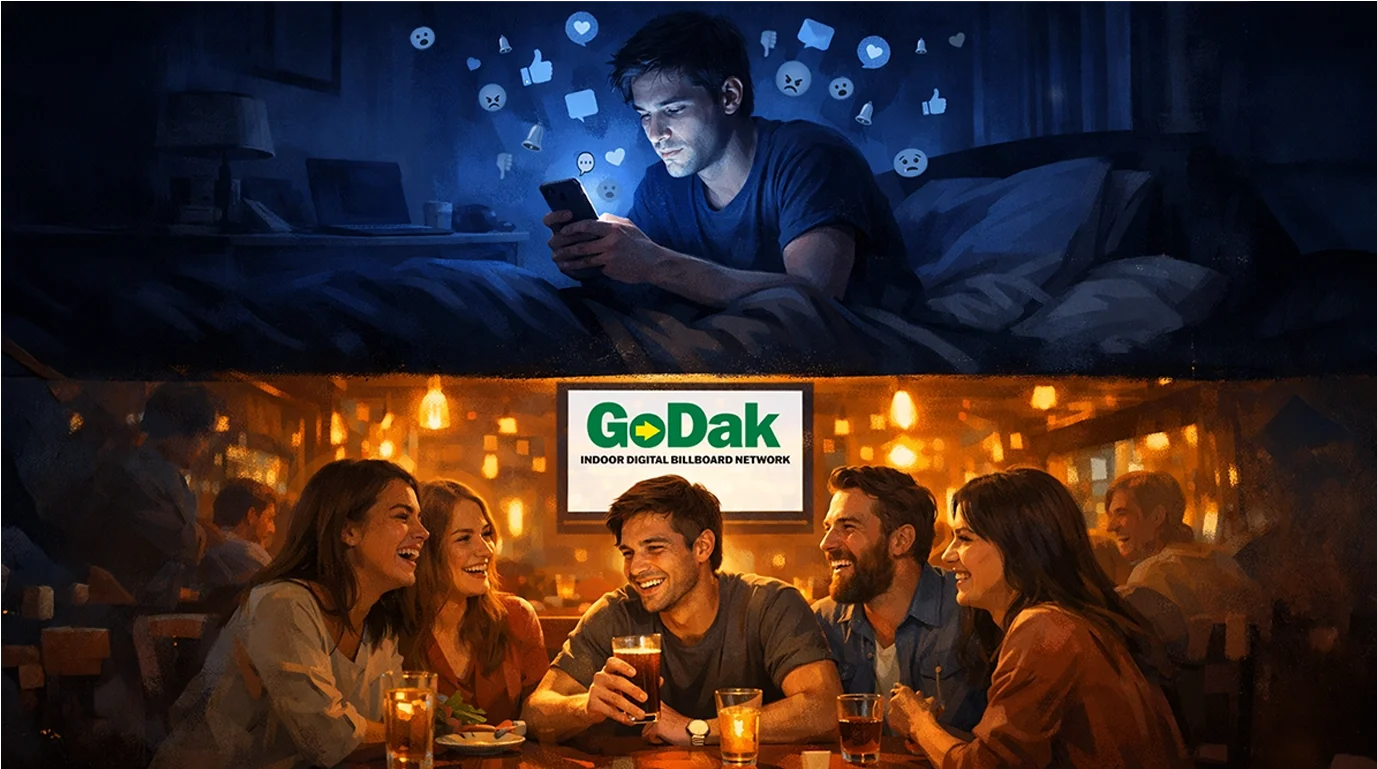
A little compare-and-contrast from the GoDak perspective
Every media channel exists inside a certain environment. The way people interact with media, marketing, and their communities has changed a lot over the past twenty years. Taking a few minutes to compare social media and what we like to call the social setting helps put some of those changes into perspective.
Quick note before we dive in: this is a little longer blog post than we normally write. But the ideas here are worth exploring.
We All Know Social Media
Social media clearly has power in the marketing world. Anyone working in advertising knows you’re always weighing different tools- reach, cost, engagement, return on investment, all the usual things. It is often a first-step marketing tool for new or small businesses and a useful channel for larger, established companies as well.
There is no question social media can play an important role. But the environment has changed substantially.
Social Media Isn’t What It Used to Be
When social media first hit the scene in the mid-2000s, it was honestly pretty amazing.
Before that, staying connected meant phone books, email , or the once mighty mailed letter. Suddenly you could now reacquaint and stay in touch with friends, classmates, and acquaintances , even people across the world, in ways that didn’t really exist before.
Early social media felt fun. It felt positive. It actually felt… social.
Today the environment feels different.
Feeds are busy. Arguments are common. Sponsored posts and ads are now super saturated. And there’s always that slightly creepy feeling that your phone might be listening or tracking you (which it probably is… but that’s a rabbit hole for another day).
All of that muddles up and steals the original purpose- staying connected with people and communities you care about.
At the same time, the number of platforms has multiplied. Early on there were only a few places to be. Now there are dozens. Businesses can twist themselves in circles trying to decide which platforms matter and where their customers actually spend time.
At the end of the day, social media still can have real power, but it’s clearly not the same environment it once was.
The Social Setting Is Actually Social
Here’s something interesting when you stop and think about it. Social media is called social media… but most of the time it’s actually a pretty solo activity. Usually it’s one person sitting alone with their phone scrolling through content. People might comment or react, but the experience itself is largely individual.
Now compare that to a social setting.
A bar. A restaurant. A barbershop. A gathering place.
And…
People are talking. They’re interacting. They’re laughing. They’re with friends and neighbors.
The environment is completely different. And that difference matters more than people might realize.
Social media happens alone on your phone. Social settings happen with people in your life.
Advertising in the Social Setting
GoDak operates indoor digital billboards in places where people naturally gather- restaurants, bars, barbershops, and other local spots where communities spend time together. In social settings, conversations spark all kinds of things.
“Hey, we should try that place.”
“Did you see that event coming up?”
“I didn’t know they offered that service.”
You never really know what’s going to trigger a conversation. But when people glance up and see a familiar name, a local business, or a solution to a problem they’ve been thinking about, something sticks.
In a social setting, advertising isn’t just information flying past someone’s eyeballs. It becomes part of the environment people are sharing together.
The Local Factor
Another important piece of the social setting is local recognition. The businesses advertising on GoDak are local and regional. These are places people know. Owners people recognize. Businesses that are part of the community. That creates a very different interaction than what happens on a social media feed.
Think about your own social media sometime. If you’ve had an account for years, you might have thousands of connections or followers. Every once in a while you scroll past someone and think:
Wait… who is that again?
But in a local social setting, you’re seeing names and businesses you actually recognize. These are the businesses that help build the communities we live in.
The Trust Factor
Another difference that doesn’t get talked about much is trust.
You’re scrolling through social media and an ad pops up for some interesting product. Maybe it catches your attention just enough to make you pause. But then the questions start.
Who are these people?
Where are they located?
Is this a real company or some drop-shipping operation halfway across the world?
Even if the product looks interesting, there’s usually a little hesitation because you just don’t know who you’re dealing with.
Now compare that to advertising in the social setting. Most of the promotions people see on GoDak screens are actual businesses in the community or the region.
You know the name (you might even know the owner).
There’s an address.
There’s a storefront.
There’s a presence in the community.
And whether we consciously think about it or not, that creates a certain level of built-in trust. These aren’t anonymous companies floating around the internet. They are businesses that are part of the same communities we live in.
And that makes a difference.
The Quiet Quitting From Social Media
There is a silent shift happening lately: A lot of people are quietly stepping back from social media.
Not necessarily deleting their accounts. But they are spending way less time there.
The negativity gets tiring.
The arguments get exhausting.
The constant stream of content becomes noise.
So people unplug. And where do they go instead?
Back into the real world and into actual social settings.
Letting the Message Soak
This is where the social setting model has an interesting advantage.
A GoDak ad segment can run for weeks or months. That means the effort put into creating that message doesn’t disappear in a few hours. Instead, it soaks.
People see it again and again over time. And because it’s in a social setting where people are relaxed, talking, and engaged with their surroundings, the message has room to settle in.
You can also change it when you want. Promote an event. Swap in a seasonal message. Highlight a new offering.
It’s flexible. But it isn’t fleeting.
Why Social Settings Still Matter (Especially in North Dakota)
If there’s one place where social settings are an integral part of our daily life, it’s North Dakota.
People here still get together. They go out. They meet friends. They run into neighbors. They talk about what’s happening in the community.
That culture of gathering is part of what makes our communities strong.
And it’s exactly the environment where local businesses should be visible.
A Final Thought
If there’s one thing we believe at GoDak, it’s that community is the centerpiece. People still gather. They still talk. They still share ideas and recommendations.
And when businesses are visible inside those real-world social settings, something interesting happens: Messages don’t just get seen, they get talked about.
Local businesses.
Local venues.
Local visibility.
If you’re curious about how your business could be part of the GoDak indoor digital billboard ad network, give us a shout, we’d love to visit.